
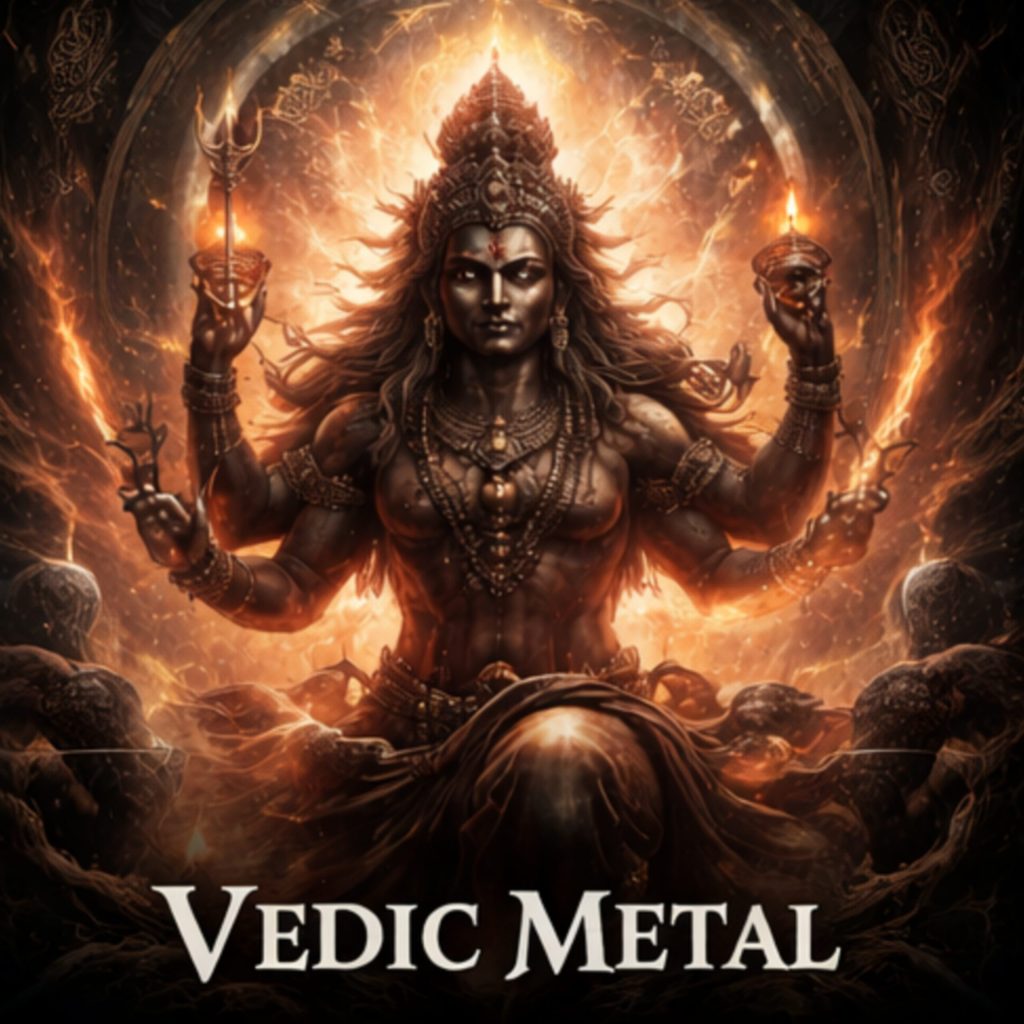
Ancient Revelation Through Extreme Sound
Vedic Metal is a subgenre of metal rooted in the spiritual and philosophical traditions of the Vedas — the ancient sacred texts of India. It merges the sonic intensity of extreme metal with concepts drawn from Hindu philosophy, Sanskrit scripture, and dharmic cosmology.
Unlike metal that merely borrows mythological aesthetics, Vedic Metal engages deeply with scriptural thought. Its foundation lies in metaphysics: Brahman (ultimate reality), Atman (self), karma, dharma, moksha, cosmic cycles, and the interplay between destruction and renewal.
In Vedic Metal, distortion becomes doctrine — not of dogma, but of transcendence.
Origins of Vedic Metal
The term “Vedic Metal” became widely associated with the Singaporean band Rudra, formed in the early 1990s. Often regarded as pioneers of the genre, Rudra integrated Sanskrit lyrics, Vedic philosophy, and Hindu cosmology into a framework of blackened death metal.
Rather than using religious themes for provocation, Rudra approached Vedic knowledge with reverence and philosophical engagement. Their albums explored concepts from the Upanishads, the Bhagavad Gita, and Shaivite theology — positioning metal as a vehicle for spiritual inquiry rather than rebellion.
Through this synthesis, Rudra helped establish Vedic Metal as a distinct spiritual direction within extreme music.
Defining Characteristics
Vedic Metal is not defined solely by geography or ethnicity. It is defined by philosophical depth and scriptural integration.
Common elements include:
- Lyrics inspired by Vedic scriptures and Sanskrit texts
- References to deities such as Shiva, Vishnu, Kali, or Agni
- Exploration of karma, liberation (moksha), and cosmic cycles (samsara)
- Use of Sanskrit language or mantric phrasing
- Integration of traditional melodic motifs or classical influences
Musically, Vedic Metal often intersects with death metal or black metal, yet its thematic core differentiates it from generic mythological metal.
The focus is not fantasy — it is metaphysical reality as described in Vedic thought.
Philosophy Over Exoticism
One of the strengths of authentic Vedic Metal is its resistance to superficial exoticism. The Vedas are not used as aesthetic decoration. Instead, the music reflects philosophical contemplation.
Themes frequently explored include:
- The illusion of ego (maya)
- The unity of Atman and Brahman
- The cyclical destruction embodied by Shiva
- The transformative fire of knowledge (jnana)
In this sense, Vedic Metal transforms extreme sound into a medium for scriptural reflection.
Intensity becomes tapas — spiritual heat.
Other Bands Within the Spectrum
While Rudra are widely credited as pioneers, other bands have drawn from Hindu and Vedic themes within extreme metal contexts.
Examples include:
- Demonic Resurrection (India) – blending extreme metal with mythological and dharmic themes.
- Karttikeya (Russia/India connection) – incorporating Sanskrit lyrics and Hindu philosophy into melodic death metal structures.
- Cult of Fire (Czech Republic) – known for integrating Hindu spiritual symbolism and Sanskrit elements into atmospheric black metal.
While not all explicitly label themselves as “Vedic Metal,” their engagement with Vedic cosmology contributes to the broader spiritual metal landscape influenced by Hindu philosophy.
Vedic Metal and Spiritual Metal
Vedic Metal can be understood as a specific expression within the broader framework of Spiritual Metal. Where Spiritual Metal may draw from multiple traditions, Vedic Metal centers specifically on Vedic scripture and Hindu metaphysics.
It transforms extreme metal into a contemplative platform for ancient revelation.
Rather than rejecting spirituality, it intensifies it.
Rather than opposing tradition, it amplifies it.
Vedic Resonance Within KI BARAK SELEM
Within KI BARAK SELEM, Vedic influence appears not as imitation, but as philosophical resonance. Concepts of cosmic order, sacred vibration, and metaphysical duality align naturally with Balinese Hindu cosmology.
Balinese spirituality itself carries Vedic roots, expressed through local ritual, mantra, and ceremonial structure. When integrated into extreme metal frameworks, this resonance becomes part of a wider spiritual metal continuum.
In this context, Vedic Metal is not simply a genre label — it is a bridge between ancient scripture and modern amplification.
The Sacred Within Distortion
Vedic Metal challenges the assumption that extreme music must be nihilistic. Instead, it asserts that intensity can illuminate transcendence.
The roar becomes mantra.
The tremolo becomes vibration.
The breakdown becomes dissolution of ego.
Ultimately, Vedic Metal stands as proof that ancient wisdom can move through modern sound — not diluted, but intensified.
It is not rebellion against the sacred.
It is revelation through it.