
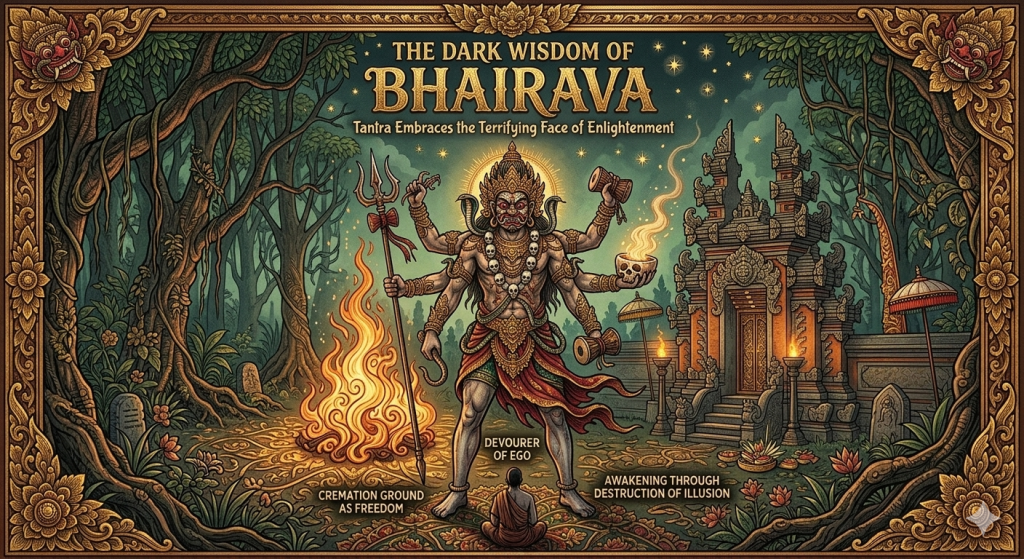
Throughout many spiritual traditions, the divine is often portrayed as peaceful, compassionate, and serene. Gods and enlightened beings are commonly associated with calmness, harmony, and gentle wisdom.
Yet within the deeper layers of Tantric spirituality, there exists a radically different expression of the divine.
A form that is fierce, terrifying, and uncompromising.
This form is known as Bhairawa.
At first glance, Bhairawa may appear frightening. He is often depicted surrounded by skulls, flames, wild hair, and the desolate atmosphere of cremation grounds. But behind this terrifying imagery lies a profound spiritual philosophy — one that speaks about awakening, transformation, and the destruction of illusion.
To understand Bhairawa is to understand a central teaching of Tantra:
True liberation can only occur when the ego is destroyed.
The Meaning of Bhairawa
The name Bhairawa (or Bhairava) carries layered meanings within Sanskrit interpretation.
Traditionally it is understood through symbolic syllables:
- Bha — illumination or divine light
- Ra — the fire that burns impurities
- Wa — the breath or expansion of life
Together, these elements represent a force that illuminates truth while burning away ignorance.
Unlike deities who guide gently through compassion alone, Bhairawa represents a more intense form of spiritual awakening. His presence is like lightning — sudden, powerful, and impossible to ignore.
In Tantric philosophy, Bhairawa symbolizes the moment when illusion collapses and consciousness is forced to confront reality.
This experience may feel terrifying to the ego.
But to the awakened mind, it is liberation.
Bhairawa in Tantric Spiritual Practice
Tantra differs from many spiritual systems because it does not reject the darker aspects of existence.
Fear, death, chaos, desire, and destruction are not avoided.
Instead, they are transformed into pathways toward realization.
Bhairawa embodies this transformative power.
In sacred texts such as the Vijñāna Bhairava Tantra, Bhairawa is not simply described as a deity in a mythological sense. Rather, Bhairawa represents a state of awakened awareness.
This state arises when the ordinary mind suddenly transcends its limitations.
Moments of Bhairawa-consciousness can arise through various experiences, including:
- meditation
- breath awareness
- sacred sound or mantra
- deep silence
- intense emotional states
- sudden shock or realization
In these moments, the rigid structure of the ego briefly dissolves.
What remains is pure awareness.
That moment — when identity disappears and consciousness expands — is the essence of Bhairawa.
The Symbolism of the Cremation Ground
One of the most powerful images associated with Bhairawa is the cremation ground.
For those unfamiliar with Tantric symbolism, this setting can appear dark or disturbing. But in spiritual philosophy, the cremation ground represents a powerful truth about existence.
It is the place where all human identities ultimately end.
Wealth, social status, pride, and ego all dissolve in the same fire.
Nothing remains except the reality of impermanence.
For Tantric practitioners, contemplating this reality is not meant to create despair or fear.
Instead, it creates freedom.
When a person deeply understands the impermanent nature of the ego and identity, attachment begins to dissolve. From this awareness arises a more authentic experience of life.
This is why Bhairawa is sometimes described as the guardian between illusion and awakening.
Bhairawa as the Devourer of Ego
Perhaps the most misunderstood aspect of Bhairawa is his terrifying nature.
The skulls, flames, and fierce expressions often associated with Bhairawa are not meant to represent cruelty or violence.
They symbolize the destruction of illusion.
In spiritual terms, the greatest obstacle to awakening is the ego — the mental construct that defines identity, pride, fear, and attachment.
Bhairawa represents the force that devours this false self.
When the ego dissolves, the practitioner experiences reality without distortion.
What remains is pure consciousness.
From this perspective, Bhairawa is not a destroyer of life.
He is a destroyer of illusion.
Echoes of Bhairawa in Balinese Mystical Thought
Although Tantric traditions originated primarily in India, echoes of similar spiritual ideas can be found across many cultures, including within layers of Balinese mystical philosophy.
Concepts involving the confrontation of inner darkness, the balance between destructive and creative forces, and the transformation of fear into wisdom are themes that resonate deeply within various spiritual traditions.
These ideas continue to inspire contemporary artistic expressions today.
One unexpected medium for expressing these ancient spiritual ideas is extreme metal music.
With its raw intensity, ritualistic atmosphere, and confrontation with darkness, extreme metal can become a powerful channel for exploring philosophical themes that traditional language sometimes struggles to express.
When Philosophy Becomes Sound
Ancient spiritual ideas often find new life through art and music.
In modern ritual-inspired metal, the imagery and philosophy of Bhairawa can be transformed into sonic landscapes — combining intensity, sacred symbolism, and atmospheric sound.
One such exploration appears in the third single released by the Balinese ritual metal project KI BARAK SELEM.
The composition draws inspiration from the fierce spiritual symbolism of Bhairawa, merging extreme metal with elements of mantra, atmosphere, and mystical philosophy.
For listeners who are curious to explore this sound ritual further, the track can be discovered through the official KI BARAK SELEM website or experienced directly through digital music platforms.
Because sometimes, philosophy is not only meant to be read.
Sometimes it must also be heard.