
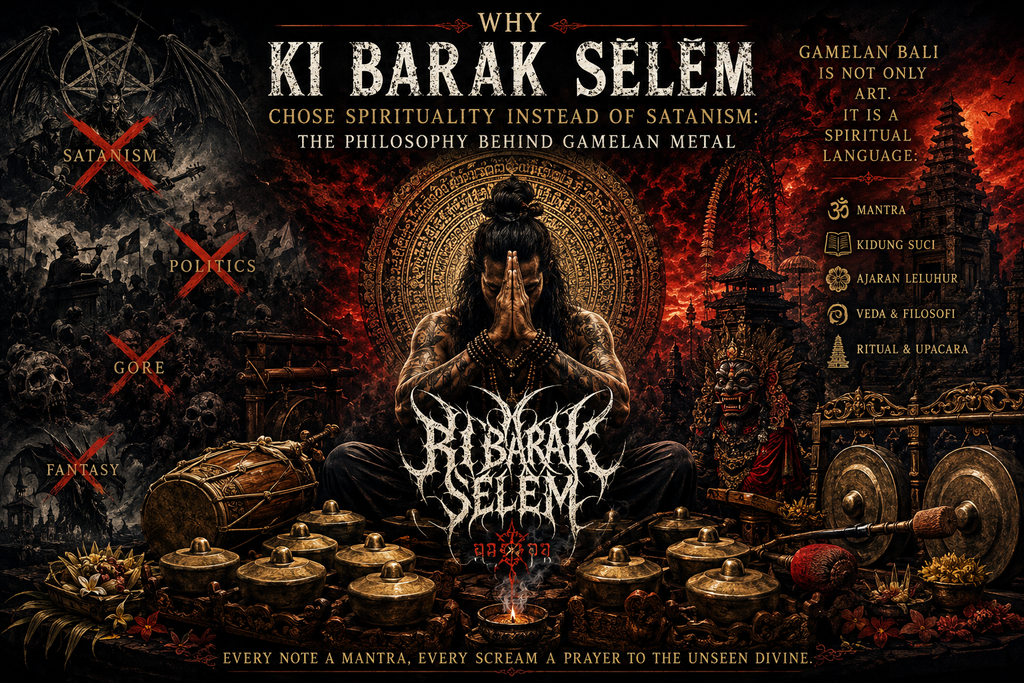
Introduction: A Question We Hear Quite Often
Why would an extreme metal band choose to write songs about ancient spirituality, sacred mantras, ancestral teachings, and traditional hymns instead of following the more familiar themes of politics, Satanism, violence, horror, or fantasy?
This is probably one of the most common questions directed at Ki Barak Selem.
The answer is actually very simple: because the music of Ki Barak Selem was never intended to imitate existing formulas within the global metal scene.
Ki Barak Selem was born from a different cultural environment. Its musical foundation is deeply rooted in Balinese gamelan, while its lyrical inspiration emerges from ancestral spirituality, Vedic philosophy, sacred literature, traditional mantras, and ancient ritual practices that have shaped Balinese civilization for centuries.
For us, separating gamelan from spirituality would be like separating a tree from its roots.
To understand why Ki Barak Selem chose this path, we must first understand the true role of gamelan within Balinese culture.
Gamelan Is More Than Music
Outside Indonesia, gamelan is often introduced as a traditional musical ensemble or a form of performing art.
While that description is not entirely incorrect, it only reveals one dimension of a much deeper cultural reality.
In Bali, gamelan is closely connected to religious ceremonies, communal rituals, temple festivals, sacred dances, traditional theater, and ritual chanting. It accompanies important moments within society, from celebrations and artistic performances to ceremonies dedicated to maintaining harmony between human beings, nature, and the spiritual realm.
For generations, the sound of the gong, metallophones, drums, cymbals, and bamboo flutes has become part of Bali’s collective memory.
Gamelan is not merely entertainment.
It is also a cultural language.
More importantly, it is a spiritual language.
This understanding became one of the fundamental principles behind the creation of Ki Barak Selem.
If the musical foundation comes from gamelan, then the philosophical foundation should emerge from the same cultural ecosystem.
Why Not Satanism, Politics, Gore, or Fantasy?
There is absolutely nothing wrong with these themes.
Politics has produced countless legendary albums.
Fantasy has inspired entire musical movements.
Horror and gore have become integral parts of several extreme metal subgenres.
Satanism has played a significant role in shaping the identity of black metal.
However, none of these themes represent the cultural experience that Ki Barak Selem seeks to explore.
Choosing spirituality over Satanism was never an act of rejection.
It was an act of authenticity.
We chose to speak about what we know, what we inherited, and what continues to shape our cultural identity.
Ancient teachings, sacred hymns, ritual traditions, and philosophical concepts preserved within Balinese culture provide an almost limitless source of inspiration.
Rather than importing narratives from outside our cultural environment, we decided to explore the spiritual heritage that has always existed around us.
The Spiritual Dimension of Gamelan Metal
Many metal bands incorporate traditional instruments to create an exotic atmosphere.
There is nothing unusual about that approach.
However, Ki Barak Selem follows a different philosophy.
Gamelan is not used as a decorative element.
It is not added simply to create an ethnic sound.
Instead, it serves as the foundation upon which the entire musical structure is built.
Because of this, the lyrics cannot be separated from the philosophical world that gave birth to gamelan itself.
Mantras, sacred hymns, ancestral teachings, and spiritual concepts naturally become part of the musical narrative.
Without its spiritual roots, gamelan becomes only a collection of sounds.
Without its cultural context, Gamelan Metal loses its soul.
Darkness Does Not Always Mean Evil
One of the biggest misconceptions surrounding Ki Barak Selem concerns the idea of darkness.
Within popular culture, darkness is often associated with evil, destruction, fear, or malevolent forces.
However, darkness can also represent introspection, transformation, mystery, and the exploration of hidden aspects of human existence.
Many ancient spiritual traditions recognize that transformation often begins in darkness.
Seeds germinate beneath the earth.
Meditation takes place in silence.
Self-discovery frequently emerges through confrontation with the unknown.
The darkness explored by Ki Barak Selem is not the glorification of evil.
It is the recognition that human beings must confront both light and shadow to achieve a deeper understanding of themselves.
Extreme Metal as a New Ritual Language
Why combine spirituality with extreme metal?
Because extreme metal possesses an emotional intensity capable of expressing experiences that are often difficult to communicate through conventional musical forms.
The aggression of distorted guitars, the relentless force of blast beats, the hypnotic repetition of traditional rhythms, and the raw power of extreme vocals create a sonic landscape that can mirror the intensity of ritual experience.
Within Ki Barak Selem, these musical elements are transformed into a new language.
The scream becomes a prayer.
The blast beat becomes a heartbeat.
The mantra becomes a shield.
The ritual becomes music.
Extreme metal provides the energy.
Gamelan provides the cultural foundation.
Spirituality provides the meaning.
Together, they create what we call Gamelan Metal.
Every Note a Mantra, Every Scream a Prayer
Ki Barak Selem does not attempt to recreate the past.
Neither does it seek to preserve tradition inside a museum.
Instead, it attempts to reinterpret ancient wisdom through a contemporary musical language.
Our goal is not to make metal sound more exotic by borrowing the sound of gamelan.
Our goal is to bring the spirit that gave birth to gamelan into extreme metal.
This is why our songs speak about spirituality, ancestral teachings, sacred mantras, and traditional hymns.
This is why we chose a different path.
And this is why every composition created by Ki Barak Selem follows a simple principle:
Every Note a Mantra. Every Scream a Prayer to the Unseen Divine.