
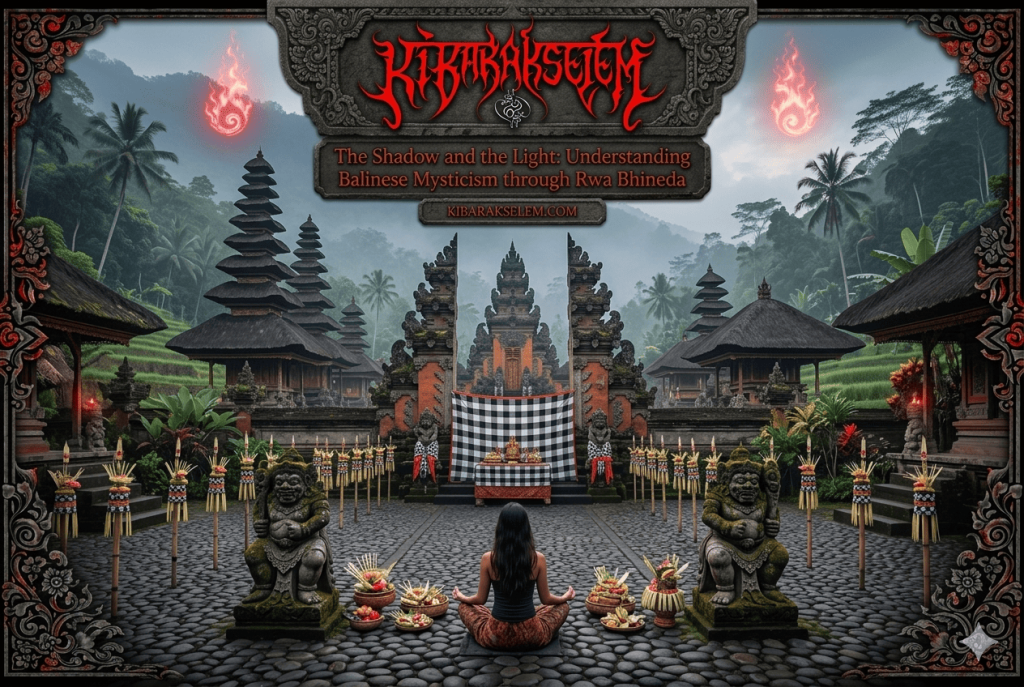
In a world that constantly forces us to choose a side—good versus evil, light versus dark, positive versus negative—the ancient spiritual wisdom of Bali offers a much deeper, more grounded perspective. True spiritual mastery isn’t about destroying the dark; it is about mastering the balance between all cosmic forces.
At the heart of this ancestral philosophy lies the sacred concept of Rwa Bhineda.
What is Rwa Bhineda?
Literally translating to “two opposites,” Rwa Bhineda is the Balinese concept of cosmic dualism. It dictates that the universe and everything within the self are constructed from opposing yet complementary forces: Prana (Life) and Apana (Death), Suka (Joy) and Duka (Sorrow), Light and Shadow.
Unlike Western dualistic paradigms where the light must conquer and annihilate the dark, Balinese mysticism teaches that both forces are absolutely necessary for cosmic equilibrium. You cannot perceive the light without the existence of the shadow, and you cannot appreciate peace without understanding chaos.
The Path of Ki Barak Selem: When Ritual Becomes Sound
In the spiritual landscape of Bali, energy itself is entirely neutral; it is the intention and spiritual maturity of the practitioner that defines its manifestation. This is why the path of Ki Barak Selem does not fear the dark. Instead, it walks straight into the shadows with an open eye, transforming raw existential energy into a powerful shield of spiritual protection.
This profound concept of balancing opposites is not just an abstract theory—it is the very DNA that drives the sonic machinery of Ki Barak Selem. Through heavy distortion, crushing metal riffs, and the hypnotic, cyclical pulse of traditional Balinese Gamelan, these spiritual concepts are transmuted into ritualistic soundwaves.
Sonic Manifestations of Cosmic Duality
If you look closely at the musical journey of Ki Barak Selem, every single release serves as an auditory portal into these ancient teachings:
- The Invocations of the Divine: In the debut single “महाकाली (Mahakali) – You’re the True Protector,” the absolute destructive force of the cosmic mother is invoked not as an act of evil, but as a necessary purification to annihilate the false ego and reveal ultimate spiritual truth.
- The Structure of the Self: The second single, “Kanda Pat Sari,” explicitly explores the esoteric inner structure of the human soul. It bridges the spiritual teachings of the land with heavy, atmospheric arrangements, reminding us of our eternal connection to Sanghyang Panca Mahabutha.
- The Ultimate Surrender: This spiritual trajectory culminates in the latest monumental release, “Kidung Bhairawa Prabhu.” It represents the final movement toward total ego dissolution. The heavy, processional mid-tempo riffs combined with traditional pentatonic scales act as a ritual apex, devouring spiritual ignorance and anchoring a dense, ceremonial atmosphere.
Experience the Ritual
To truly absorb the essence of Rwa Bhineda and the unseen realms of Bali, words on a screen are never enough. You must feel the vibrations. The dark, ritualistic atmospheres, the metallic overtones of the gamelan, and the crushing weight of spiritual extreme metal are waiting for you.
Experience the sonic offering created entirely by Kadek D. Putra Pande (BRUTALSICK). Head over to your preferred streaming platforms now:
- Listen to the crushing ritual of “Kidung Bhairawa Prabhu“ (3rd Single, 2026).
- Revisit the foundational invocation of “महाकाली – You’re the True Protector“ and the mystical structures of “Kanda Pat Sari.”
All releases are available worldwide on Spotify, Apple Music, Bandcamp, and the official Ki Barak Selem YouTube Channel. Immerse yourself in the sound where mantra, gamelan, and darkness become one.
What part of your life needs more balance today? Let us know in the comments below, and don’t forget to stream our latest ritual tracks to align your inner frequency.