
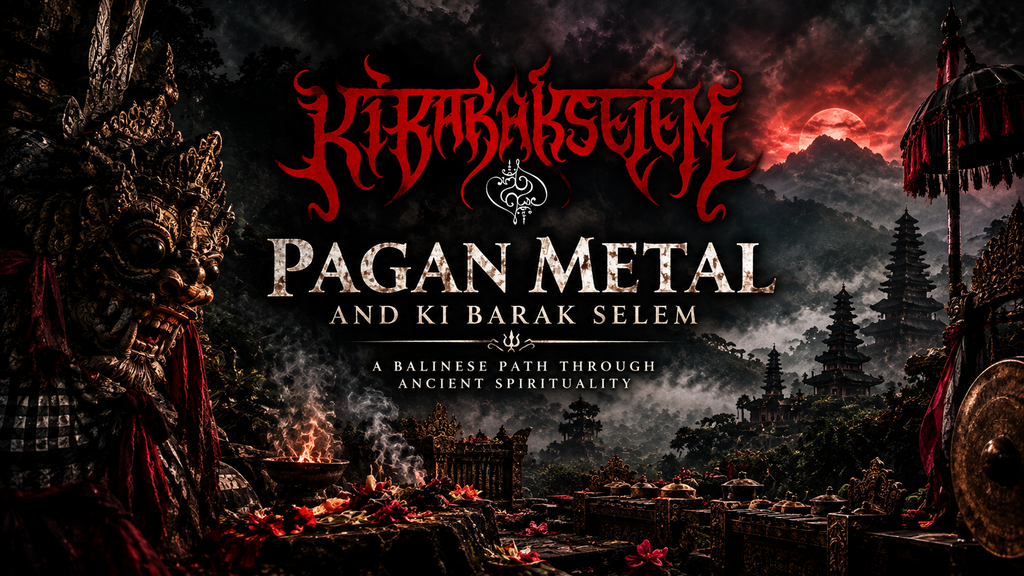
Exploring the connection between Pagan Metal, ancestral wisdom, and the ritual sound of Bali.
Beyond the Boundaries of Metal
Metal has always been more than a musical genre. For many artists, it is a way to explore identity, history, spirituality, and the relationship between humanity and the unseen world.
Within this broad landscape, Pagan Metal has become a musical expression connected to ancestral traditions, pre-Christian beliefs, mythology, nature, and spiritual philosophies. Although its roots are strongly associated with European metal scenes, its underlying ideas can also be explored through different cultural traditions around the world.
KI BARAK SELEM approaches this territory from Bali, Indonesia. Rather than following European mythology or reproducing a familiar folk-metal formula, this one-man project explores the mystical and spiritual heritage of Bali through extreme metal, traditional gamelan, sacred chants, and ancestral teachings.
Its musical identity remains Balinese Mysticism Ritual Metal. Pagan Metal provides another perspective through which listeners can understand the project’s relationship with ancient beliefs, cultural identity, and spiritual expression.
What Is Pagan Metal?
Pagan Metal is a broad term used to describe metal music influenced by pre-Christian traditions, ancestral beliefs, mythology, nature worship, and spiritual or cultural identities outside dominant religious frameworks.
It does not have one fixed musical formula. Some bands build their sound around Black Metal, while others combine elements of Death Metal, Folk Metal, Doom Metal, or atmospheric and progressive music. Traditional instruments may be present, but they are not essential to every interpretation of the genre.
The connection between music and belief is often more important than the instrumentation itself. Lyrics, atmosphere, historical references, and the artist’s cultural background can all contribute to a Pagan Metal identity.
Bands such as Bathory, Enslaved, Primordial, Moonsorrow, and Skyforger have each contributed to different interpretations of this musical landscape. Their approaches are distinct, ranging from mythological and ancestral themes to nature, cultural memory, and philosophical reflection.
The Norwegian band In the Woods… also deserves recognition in discussions of the genre’s early development. Associated with Pagan Metal during the 1990s, the band explored paganism, nature, and atmosphere through an experimental form of extreme metal rather than relying on the folk instrumentation that later became common in some related styles.
These different approaches demonstrate that Pagan Metal is not defined by one geographical region or a single sound. Its meaning depends on how music, cultural identity, and spiritual ideas come together.
A Different Cultural Perspective: Bali, Indonesia
Bali possesses a rich spiritual and cultural heritage expressed through ceremonies, traditional performing arts, sacred literature, mantras, kidung, and philosophical teachings passed down through generations.
For KI BARAK SELEM, these traditions are not simply decorative elements to make metal sound exotic. They form the foundation of the project’s creative direction.
The project draws inspiration from Balinese mystical teachings, ancestral concepts, and spiritual subjects found in traditions associated with Butha Kala, Kanda Pat, Bhairawa, and other esoteric themes. These subjects are approached through personal interpretation, musical expression, and philosophical reflection.
This perspective offers a different cultural point of reference within the wider Pagan Metal landscape. Instead of borrowing the mythology of another region, KI BARAK SELEM develops its music from the spiritual and cultural environment of its own homeland.
The result is not an attempt to imitate European Pagan Metal. It is a Balinese interpretation of the broader relationship between extreme music, ancestral identity, and spiritual tradition.
When Gamelan Becomes the Foundation
One of the defining characteristics of KI BARAK SELEM is its use of traditional Balinese gamelan as a central musical element.
The sound of gamelan is not added merely as an ethnic introduction or an occasional interlude. Its melodic patterns, pentatonic character, metallic resonance, and cyclical rhythms help shape the compositions themselves.
Distorted guitars, bass, drums, and extreme-metal vocals are arranged around this foundation. Rather than forcing gamelan to follow the conventions of Western metal, the composition allows its traditional musical character to influence the direction of the arrangement.
This approach creates a meeting point between two distinct musical worlds: the ceremonial resonance of Balinese gamelan and the intensity of extreme metal.
The music can move through dark atmospheres, crushing riffs, ritualistic passages, and powerful vocal expressions. Yet the gamelan remains an essential part of the musical identity, not simply an ornamental layer.
In this context, the ritual atmosphere emerges from the relationship between the instruments, the musical structure, and the spiritual themes behind each composition.
Mantras, Kidung, and Spiritual Expression
The lyrical approach of KI BARAK SELEM is closely connected to Balinese mystical traditions and spiritual concepts.
Some compositions incorporate Sanskrit mantras and Balinese kidung, bringing ancient forms of vocal expression into a contemporary metal setting. These elements are used with the intention of preserving their spiritual atmosphere and connecting the music with the traditions that inspire it.
Songs such as Mahakali, You’re the True Protector, Kanda Pat Sari, and Kidung Bhairawa Prabhu explore different aspects of this creative direction. Through their musical and lyrical approaches, they reflect the project’s continuing interest in divine protection, ancestral concepts, and mystical philosophy.
For KI BARAK SELEM, a mantra or kidung is not simply another vocal effect. Its place in a composition is considered in relation to the meaning, atmosphere, and intention of the work.
The project does not claim to represent every aspect of Balinese spirituality, nor does it present its music as an authoritative explanation of sacred teachings. These works are personal artistic interpretations shaped by cultural roots, individual conviction, and a long-standing interest in the mystical traditions of Bali.
Why Can Ki Barak Selem Be Connected to Pagan Metal?
The connection becomes clearer when Pagan Metal is understood as a broad cultural and philosophical landscape rather than a strict musical formula.
First, KI BARAK SELEM draws upon ancestral and mystical traditions rooted in its own cultural environment. Second, its music explores spiritual themes through lyrics, chants, atmosphere, and musical structures. Third, its artistic identity is closely connected to the cultural heritage of Bali rather than to an invented fantasy world or an adopted mythology from another region.
These characteristics create meaningful points of connection with Pagan Metal.
However, KI BARAK SELEM does not need to abandon its own identity to fit within that category. The project has developed its sound around a more specific concept: Balinese Mysticism Ritual Metal.
Pagan Metal can help international listeners understand the broader context of the project, but it does not fully define every musical or spiritual aspect of its work. Ritual Metal, Spiritual Metal, Ethnic Metal, and Gamelan Metal also describe important dimensions of its approach.
Rather than choosing a label at the expense of its cultural roots, KI BARAK SELEM allows its own musical language to speak for itself.
Beyond Dogma: Music as an Offering
The use of spiritual traditions in extreme metal can invite questions about belief, cultural responsibility, and artistic intention.
For KI BARAK SELEM, the purpose is not to promote a religious doctrine, recruit followers, or tell listeners what they must believe. Its music is a personal form of expression inspired by the mystical and philosophical traditions of Bali.
Dark imagery, intense sound, and references to fierce spiritual figures are approached as part of a wider exploration of transformation, inner conflict, cosmic balance, and the human relationship with the unseen.
The project also recognizes that sacred traditions deserve more than superficial treatment. Cultural symbols and spiritual concepts carry meanings that extend beyond their visual appearance or potential impact on an audience.
The intention is therefore to approach these sources with respect while allowing them to exist within the uncompromising language of underground metal.
The music is an artistic offering, not a vehicle for dogma or proselytizing.
A Balinese Voice in the Wider Metal Landscape
KI BARAK SELEM began as a musical vision in September 1998 and was revived as a one-man project in 2023. Its journey reflects a long-standing desire to bring together extreme metal and the spiritual traditions of Bali through an individual creative process.
Every composition offers another opportunity to explore this relationship. Gamelan, distorted guitars, drums, mantras, kidung, and extreme vocals become parts of a musical language shaped by local heritage and underground metal spirit.
The project does not claim to represent all Balinese culture, nor does it seek to establish a new definition of Pagan Metal. Its purpose is more personal: to create music that reflects the traditions that inspire it while remaining faithful to the intensity and independence of metal.
In a global scene where artists continually reinterpret their cultural backgrounds through heavy music, KI BARAK SELEM follows a path grounded in Bali’s own mystical heritage.
Its identity remains clear:
KI BARAK SELEM — Balinese Mysticism Ritual Metal.
Every Note a Mantra, Every Scream a Prayer to the Unseen Divine.
Want to explore the wider history and philosophy of Pagan Metal? Read our extended journal article on Putra Pande Hub.