
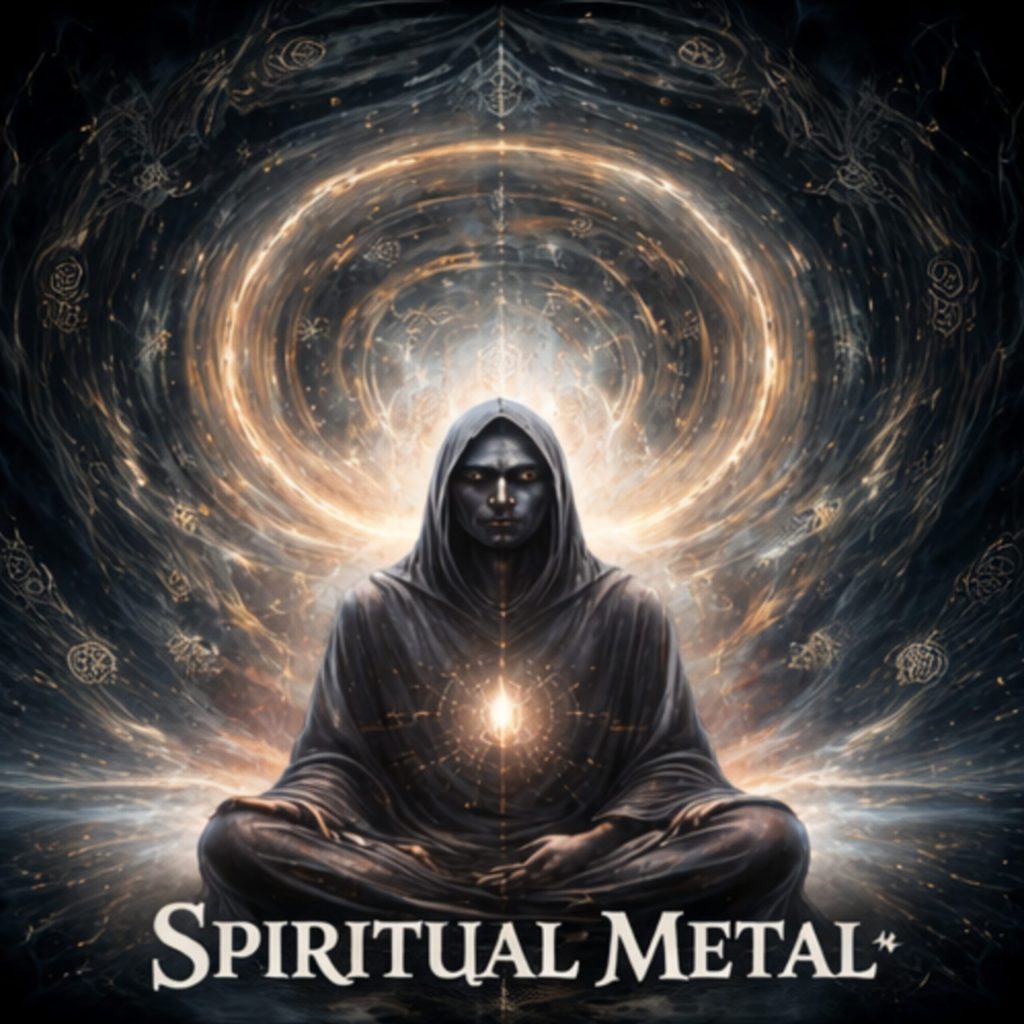
When Sound Becomes Invocation
Spiritual Metal is not defined by tempo, tuning, or distortion alone. It is defined by intention.
At its core, Spiritual Metal is a form of heavy music that seeks transcendence rather than mere aggression. While metal has long explored darkness, rebellion, and existential struggle, Spiritual Metal shifts the focus inward — toward awareness, transformation, and metaphysical inquiry.
It is not about preaching religion. It is about confronting the unseen dimensions of existence.
Beyond Aesthetic Darkness
Metal music has often been associated with themes of chaos, death, or anti-establishment expression. Spiritual Metal, however, reframes intensity as a vehicle for awakening. The distortion becomes meditation. The blast beat becomes breath. The growl becomes invocation.
Rather than using sacred symbolism for shock value, Spiritual Metal approaches spiritual themes with depth and contemplation. Lyrics may explore concepts such as ego dissolution, karma, divine archetypes, shadow integration, cosmic order, or the nature of consciousness itself.
The goal is not provocation — but revelation.
The Core Elements of Spiritual Metal
While there is no rigid formula, Spiritual Metal often includes:
- Philosophical or metaphysical lyrical themes
- Symbolism drawn from ancient traditions
- Ritualistic atmosphere or meditative passages
- Repetitive or trance-inducing structures
- A sense of inner journey rather than external confrontation
Musically, it may overlap with extreme metal, atmospheric metal, doom metal, or even ritual ambient. What distinguishes it is not subgenre classification, but spiritual orientation.
It asks questions such as:
- Who am I beyond identity?
- What lies beyond fear and ego?
- Can sound become a path to awareness?
Spirituality Without Dogma
One of the defining strengths of Spiritual Metal is its freedom from rigid institutional boundaries. It does not require adherence to a single religion. Instead, it draws insight from diverse spiritual traditions — Vedic philosophy, Tantra, indigenous mysticism, esoteric symbolism, contemplative practice, and more.
In this sense, Spiritual Metal is experiential rather than doctrinal. It invites reflection instead of demanding belief.
The listener is not instructed what to think. The listener is invited to feel, to question, to descend inward.
The Role of Intensity
Why metal?
Because intensity breaks surface consciousness.
The sonic force of metal can disrupt mental patterns and emotional stagnation. When guided by spiritual awareness, that force becomes transformative rather than destructive. Volume becomes vibration. Rhythm becomes pulse. Sound becomes catalyst.
Spiritual Metal does not soften metal’s power. It redirects it.
Spiritual Metal and KI BARAK SELEM
Within the framework of KI BARAK SELEM, Spiritual Metal manifests through the integration of sacred mantra, Balinese mysticism, and ritual atmosphere into extreme metal structures. The intention is not to aestheticize spirituality, but to channel it.
Each composition functions as an inner rite — confronting shadow, invoking archetypal forces, and dissolving false identity. The music does not seek to entertain alone; it seeks to resonate.
In this approach, Spiritual Metal becomes inseparable from what is described as Balinese Mysticism Ritual Metal — a path where distortion serves devotion, and sound becomes offering.
A Contemporary Sacred Expression
In a modern world saturated with noise, Spiritual Metal stands as a paradox: it uses loudness to reveal silence.
It reminds us that intensity and contemplation are not opposites. That darkness can be a gateway. That heavy sound can carry light.
Ultimately, Spiritual Metal is not a trend or marketing label. It is a direction — a movement toward conscious creation within heavy music.
It asks the listener not only to hear, but to awaken.