
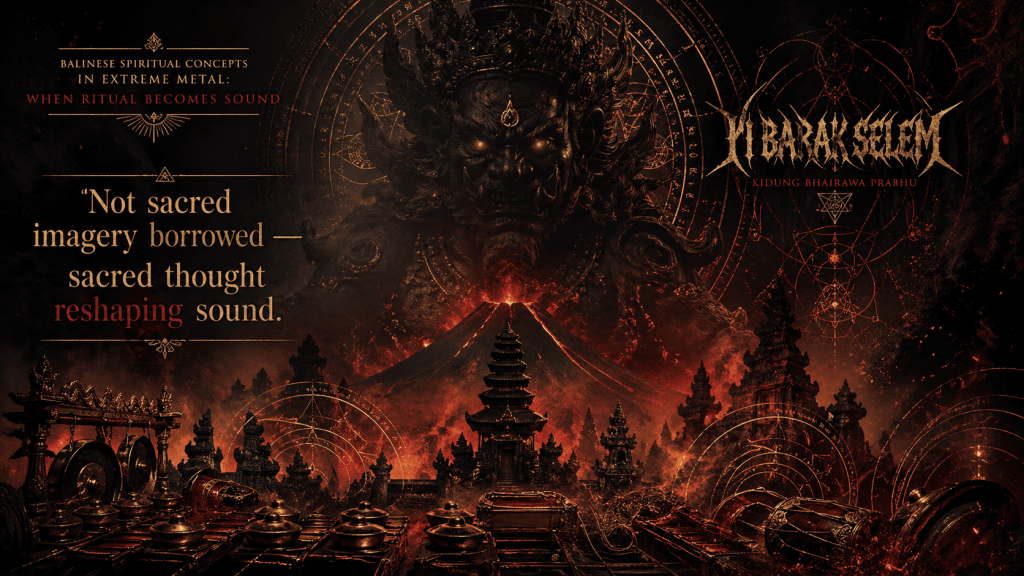
Extreme metal has often drawn from mythology, philosophy, and spiritual symbolism. Yet most encounters between traditional spirituality and heavy music remain aesthetic—symbols on album covers, fragments of folklore in lyrics, ritual imagery used as atmosphere.
But what happens when spiritual concepts do not merely decorate the music, but structure its inner logic?
This question lies at the heart of KI BARAK SELEM and particularly the single Kidung Bhairawa Prabhu.
Rather than treating Balinese spirituality as exotic ornamentation, the project approaches ancient concepts as compositional principles—forces that shape rhythm, tension, repetition, and even sonic architecture itself.
Rwa Bhineda: Duality as Tension
One of the most fundamental Balinese concepts is Rwa Bhineda — the coexistence of opposing forces.
Light and darkness.
Creation and dissolution.
Order and chaos.
In extreme metal, this duality naturally resonates through contrasts: melody against distortion, silence against impact, serenity against aggression.
Within Kidung Bhairawa Prabhu, these opposites do not seek resolution. They remain in dynamic tension, just as they do in Balinese cosmology.
The result is not conflict, but balance through polarity.
Kala: Time, Death, and Transformation
Another crucial concept is Kala, often misunderstood merely as destructive force.
In spiritual understanding, Kala is time, dissolution, and the movement through which forms decay so consciousness may transform.
This is central to Bhairawa symbolism.
In musical terms, this appears not only in lyrical themes of ego dissolution, but in processional riff structures, cyclical repetition, and mantra sections that feel suspended outside ordinary song form.
The music does not rush toward climax.
It unfolds like ritual time.
Mantra as Sonic Function
In many traditions, mantra is not poetry but vibration.
Its purpose is not descriptive, but operative.
This idea deeply informs the ritual bridge in Kidung Bhairawa Prabhu, where chant functions not as interlude, but as spiritual center.
Repetition here is not redundancy.
It is activation.
And in that sense, mantra and extreme metal—both relying on trance through repetition and intensity—may share more common ground than often assumed.
Sound as Offering
Traditional Balinese spiritual aesthetics often understand sound itself as offering.
Bell resonance, gamelan overtones, mantra recitation—these are not simply musical events.
They are devotional acts.
This perspective radically changes what heavy music can become.
Distortion is no longer only aggression.
Percussion is no longer only force.
They may also function as invocation.
This is where Balinese Mysticism Ritual Metal emerges not as genre branding, but as method.
Beyond Fusion
What KI BARAK SELEM attempts is not “metal with Balinese instruments.”
It is something more difficult:
allowing spiritual concepts to alter how metal is imagined.
That is a deeper fusion—one that happens in structure, not decoration.
And perhaps this is where ritual metal finds its true potential.
Not by borrowing sacred imagery—
but by letting sacred thought reshape sound itself.
Enter the Ritual
These ideas find their most direct expression in “Kidung Bhairawa Prabhu,” now available on major digital music platforms.
If these intersections between mysticism and extreme music speak to you, we invite you to experience the single in full.
Listen, stream, or support the release through your preferred platform—
and enter the ritual where philosophy becomes sound.