
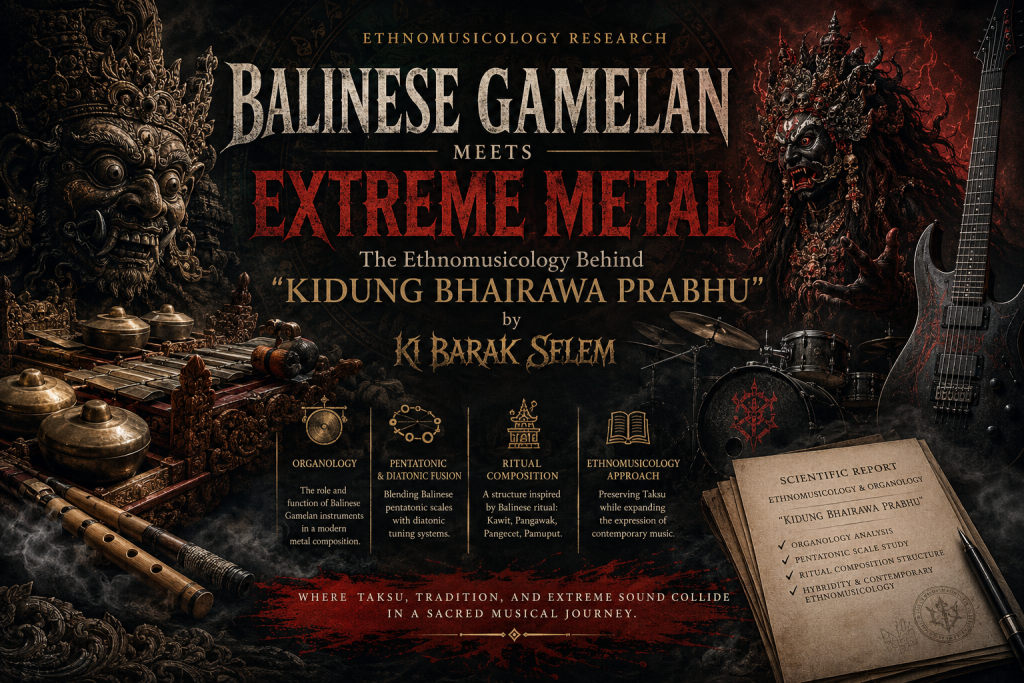
For decades, collaborations between traditional music and heavy music have been grouped under broad labels such as folk metal, ethnic metal, or world music. In many cases, traditional instruments function merely as decorative elements layered over conventional metal arrangements.
Kidung Bhairawa Prabhu challenges that approach.
Based on my recent ethnomusicological research, I argue that this composition represents a more specific musical identity: Gamelan Metal. Rather than treating Balinese instruments as sonic ornaments, the composition reconstructs the entire musical architecture by placing Balinese Karawitan at its center.
This distinction is important because it changes the relationship between tradition and modernity. The music is not “metal with a few gamelan sounds.” Instead, it is a compositional framework in which Balinese musical principles actively shape the identity of the work itself. This argument became the foundation of my latest scientific report examining Kidung Bhairawa Prabhu from the perspectives of ethnomusicology, organology, instrumental interaction, and ritual composition.
What Is Gamelan Metal?
I define Gamelan Metal as a musical form in which the structural elements of Balinese Karawitan remain functionally intact while interacting with the sonic vocabulary of Extreme Metal.
This definition differs from the common practice of simply inserting traditional instruments into a metal arrangement.
In Kidung Bhairawa Prabhu, the Gamelan ensemble provides the melodic foundation, the modal framework, the rhythmic dialogue, and even the compositional structure of the song. Electric guitars, bass, and drums are integrated into that framework rather than dominating it. This creates a genuinely hybrid musical language in which neither tradition is reduced to a secondary role.
The Organology Behind the Composition
One of the primary focuses of the report is the analysis of Balinese musical instruments and their functions within the composition.
The traditional ensemble was not employed as a complete orchestral unit. Instead, individual instruments were selected according to their specific roles within Balinese Karawitan.
Gong and Kempul provide colotomic accents and low-frequency resonance.
Jublag and Penyacah establish the melodic core and become modal anchors during extreme guitar passages.
Trompong and Ugal introduce pentatonic melodic lines while directing changes in tempo and musical dynamics.
Pemade and Kantilan perform rapid kotekan patterns that interact directly with blast-beat drumming and guitar arpeggios.
The Balinese bamboo flute creates moments of stillness and ritual transition that dramatically contrast with scream and growl vocals.
Together, these instruments construct a layered musical environment in which traditional textures and modern metal aesthetics coexist without compromising their individual characteristics.
The Meeting Point Between Pentatonic and Diatonic Systems
Another important aspect of the research concerns the interaction between Balinese pentatonic tuning and Western diatonic systems.
The composition draws its tonal foundation from the five-tone Pelog system while simultaneously incorporating the tuning practices commonly found in Extreme Metal. Because Balinese scales contain microtonal intervals that differ from the twelve-tone equal temperament of Western music, combining these systems presents significant compositional challenges.
The solution was not to standardize them but to allow them to interact through layered arrangements.
Guitar riffs were synchronized with the melodic movements of Jublag and Ugal, while drum patterns were designed to complement the interlocking textures performed by Pemade and Kantilan. This approach generated a dark and ritualistic sonic atmosphere consistent with the Bhairawa aesthetic.
A Song Structured Like a Ritual
Traditional Balinese music is inseparable from ritual, and this principle extends into the structural design of Kidung Bhairawa Prabhu.
The composition follows four sequential stages inspired by Balinese Karawitan and Bhairawa ritual practice:
- Kawit: the sacred opening.
- Pangawak: the main developmental section.
- Pangecet: the ritual climax.
- Pamuput: the return to silence.
These stages replace the conventional verse-chorus model commonly found in modern popular music. As a result, the composition unfolds as a ritual journey rather than as a standard metal song.
Preserving Taksu While Expanding Musical Boundaries
One of the conclusions of the research is that Balinese musical traditions possess extraordinary flexibility.
The integration of Gamelan and Extreme Metal does not diminish the spiritual essence of Balinese music. On the contrary, it demonstrates that traditional musical knowledge can continue to evolve while preserving its aesthetic and cultural foundations.
From this perspective, Kidung Bhairawa Prabhu should not simply be viewed as another experiment in cross-cultural music. It represents an attempt to establish Gamelan Metal as a legitimate field of contemporary ethnomusical expression—one in which Balinese Karawitan remains the primary creative force.
Read the Complete Scientific Report
This article presents only a brief overview of the research.
If you are interested in Gamelan Metal, Balinese ethnomusicology, ritual music, organology, or the intersection between traditional culture and Extreme Metal, I invite you to explore the complete scientific report.
You can also access my other independent scientific publications on Balinese spirituality, theology, ritual studies, philosophy, and musicology through my Academia.edu page:
Nararya Putra Pande (Academia.edu)
Independent Academia – Nararya Putra Pande
Thank you for supporting independent research and helping preserve Balinese traditional knowledge through contemporary artistic expression.