
Bali, Indonesia — July 2026
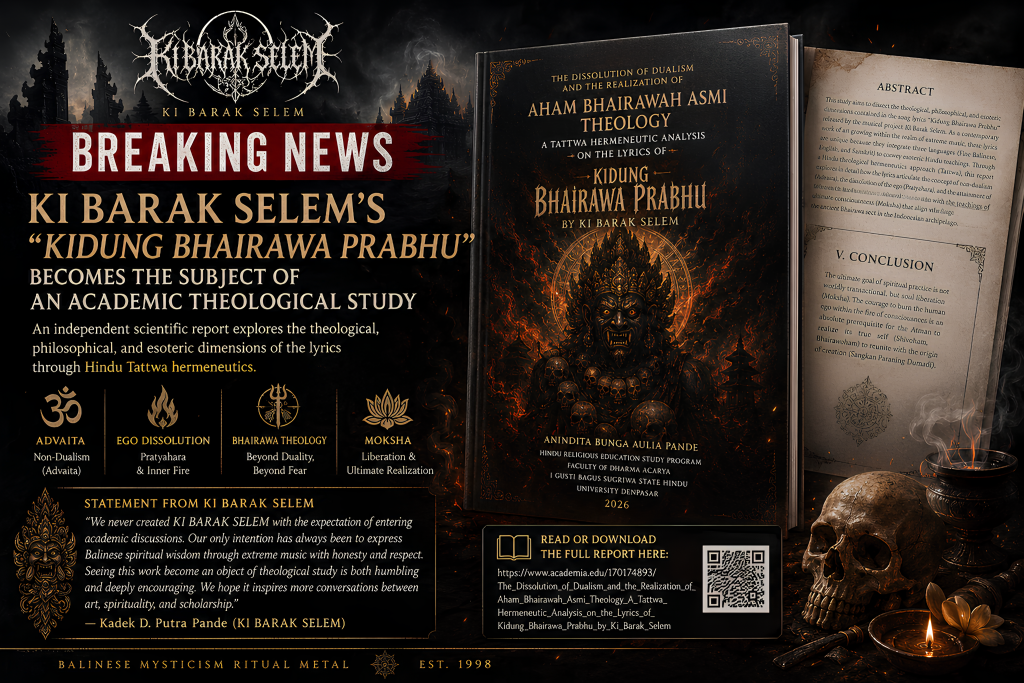
In a remarkable milestone that bridges contemporary extreme music and academic scholarship, KI BARAK SELEM’s single “Kidung Bhairawa Prabhu” has officially become the subject of an independent scientific study within the field of Hindu theology and philosophy.
The report, entitled “The Dissolution of Dualism and the Realization of Aham Bhairawah Asmi Theology: A Tattwa Hermeneutic Analysis on the Lyrics of Kidung Bhairawa Prabhu by Ki Barak Selem,” was written by Anindita Bunga Aulia Pande, a student of the Hindu Religious Education Study Program, Faculty of Dharma Acarya, I Gusti Bagus Sugriwa State Hindu University Denpasar.
Using a qualitative hermeneutic approach (Tattwa), the research examines the theological, philosophical, and esoteric meanings embedded throughout the lyrics of Kidung Bhairawa Prabhu. Rather than approaching the work solely as a musical composition, the study interprets it as a contemporary spiritual text that articulates fundamental Hindu concepts such as Advaita (Non-Dualism), the dissolution of ego (Pratyahara), Bhairawa theology, and the realization of Moksha.
One of the study’s key conclusions is that the song successfully presents a theological reinterpretation of the Bhairawa tradition by challenging common misconceptions surrounding its symbolism. Through its lyrical narrative, the research argues that symbols often associated with fear—such as cremation grounds, skulls, and sacred wrath—actually represent profound teachings concerning self-transformation, liberation from illusion (Maya), and the realization of ultimate consciousness.
The report also highlights the unique artistic identity of KI BARAK SELEM, describing the project as a contemporary expression of Balinese Mysticism Ritual Metal, where extreme metal is fused with traditional Balinese gamelan and spiritual teachings rooted in the ancient wisdom of the Indonesian archipelago. According to the research, this artistic approach demonstrates that sacred philosophical values can continue to evolve and remain relevant through modern cultural expressions without losing their spiritual essence.
For KI BARAK SELEM, this academic recognition is not viewed as an endpoint, but as another step toward encouraging meaningful dialogue between music, culture, philosophy, spirituality, and scholarly research. It also reinforces the belief that extreme music can function not only as artistic expression but also as a legitimate medium for preserving and communicating ancestral wisdom to contemporary audiences.
The complete report is publicly available and can be read or downloaded through Academia.edu:
https://independent.academia.edu/aninditabungaaulia
“We never created KI BARAK SELEM with the expectation of entering academic discussions. Our only intention has always been to express Balinese spiritual wisdom through extreme music with honesty and respect. Seeing this work become an object of theological study is both humbling and deeply encouraging. We hope it inspires more conversations between art, spirituality, and scholarship.”
— Kadek D. Putra Pande (KI BARAK SELEM)