
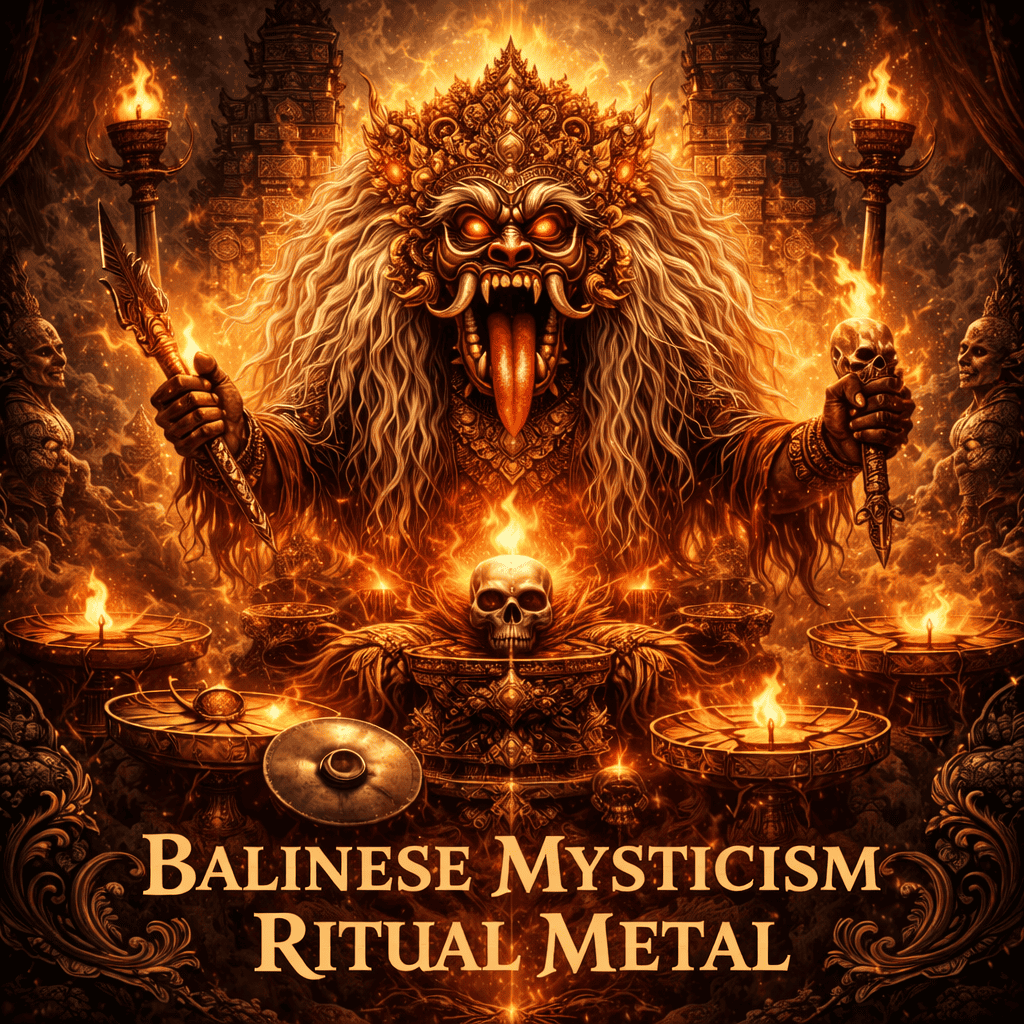
Where Ancestral Spirit Meets Extreme Sound
Balinese Mysticism Ritual Metal is not a trend, nor a stylistic experiment. It is a convergence — a meeting point between ancestral spirituality and modern extremity.
It emerges from Bali, an island where ritual is not performance but daily reality. Offerings are placed before sunrise. Mantras vibrate through temple courtyards. Gamelan echoes through ceremonies that honor both light and shadow. Within this atmosphere, sound has always carried spiritual weight.
Balinese Mysticism Ritual Metal extends that weight into amplified distortion.
Sound as Sacred Medium
In Balinese cosmology, existence moves in balance — Rwa Bhineda, the interplay of opposing forces. Creation and destruction. Shadow and illumination. Noise and silence.
Extreme Metal (death metal, black metal, doom metal), often misunderstood as chaotic or nihilistic, naturally embodies intensity and confrontation. But within this philosophy, intensity is not rebellion. It is purification.
Distortion becomes sacred vibration.
Percussion becomes ceremonial pulse.
Vocals become invocation.
The music is not written merely to be heard. It is shaped to be entered.
Ritual Structure in Sonic Form
Ritual has architecture. There is preparation. There is summoning. There is climax. There is release.
Balinese Mysticism Ritual Metal mirrors this structure. Compositions unfold like ceremonies:
- Ambient openings that function as spiritual preparation
- Rhythmic cycles that induce trance-like focus
- Explosive crescendos symbolizing confrontation with ego and shadow
- Closing passages that dissolve into reflection
This is not theatrical ritualism. It is structural ritualism — embedded within the DNA of the composition itself.
Mysticism Beyond Ornament
Mysticism here is not aesthetic decoration. It is experiential inquiry.
Balinese spirituality carries deep Vedic roots, expressed through local temple rites, sacred dance, mantra, and cosmic symbolism. These influences resonate within the music not as borrowed imagery, but as lived philosophy.
Themes of karma, cosmic order, ancestral reverence, and metaphysical duality are not layered superficially onto heavy riffs. They inform the intent behind them.
Balinese Mysticism Ritual Metal does not seek to shock the sacred. It seeks to channel it.
The Role of Gamelan and Ancestral Memory
Traditional Balinese gamelan is cyclical, percussive, hypnotic. Its metallic resonance creates an atmosphere that is both earthly and transcendental.
When integrated into extreme metal frameworks — whether directly or spiritually — it forms what can be described as Gamelan Metal: a collision of ritual rhythm and modern distortion.
This fusion is not about novelty. It is about continuity.
The ancestral memory carried in traditional sound finds new expression through amplification. The ceremony evolves, but the intention remains.
Intensity as Devotion
In many spiritual traditions, transformation requires heat — tapas, the inner fire that burns illusion.
Extreme metal provides sonic heat.
Within Balinese Mysticism Ritual Metal, aggression is not directed outward in nihilism. It is directed inward, toward ego dissolution. Toward confrontation with shadow. Toward transcendence.
Faith does not whisper here. It roars.
A Contemporary Path
Balinese Mysticism Ritual Metal stands at a rare intersection:
- Ancient ritual consciousness
- Vedic philosophical resonance
- Indigenous Balinese spirituality
- Extreme metal intensity
It does not reject modernity. It reclaims it as medium.
In a world saturated with noise, this path reintroduces intention into sound. It reminds us that heavy music can be more than rebellion — it can be offering.
Ultimately, Balinese Mysticism Ritual Metal is a journey inward.
Where distortion becomes devotion.
Where rhythm becomes rite.
Where ancestors speak through amplified vibration.
And where spirit and sound unite as one.
For KI BARAK SELEM, Balinese Mysticism Ritual Metal is not a concept to promote, but a path to walk. It is a discipline of sound, a form of inner alignment, a continuation of ancestral vibration through modern force. Each composition stands as an offering — not to audience alone, but to the unseen, to the lineage of spirit, and to the eternal balance between chaos and order. This is not music created for trend or spectacle. It is ritual carried through distortion, devotion carried through fire.